

OZ
Most theoretical accounts circulating today obfuscate the originary violence at the core of actually existing neoliberalism. Underlying the obfuscation is a particularly tenacious epistemic bias that (1) attributes foundational priority to neoliberal ideas instead of neoliberal practices, and (2) traces the genealogy of neoliberalism in the so-called global North at the expense of its genealogy in the South. In these accounts, the violence practiced in “peripheral” countries is sidelined if not fully dismissed, treated as a series of road accidents or anomalies in the elaboration of neoliberalism. Erased is the memory of the coups in Chile, Argentina, and Turkey—in 1973, 1976, and 1980, respectively—through which neoliberalism was literally forced onto societies at gunpoint. When seen from the vantage point of these devastating experiments in enforcing structural reforms, the claim that neoliberalism implemented a “soft transition” toward the eradication of liberal freedoms appears seriously flawed if not outright cruel.
We contend that the intrinsic relation between neoliberalism and authoritarianism or fascism1 can only be grasped by shifting the focus away from the US and Europe toward past and present practices elsewhere. The fact that actually existing neoliberalism entered the world scene through oppressive and often neocolonial means cannot be explained away with reference to the “illiberal” nature of the polities where such violent experiments were carried out. Extreme measures were deployed to administer the neoliberal project of weakening the power of organized labor worldwide. Intellectual doctrines possessing ideological coherence and lucidity cannot provide us with a grid of intelligibility, as if neoliberalism diligently followed blueprints devised by academics and had no history of its own. Critical theory must instead remain attentive to the decades-long unfolding of neoliberal practices whose trajectory was shaped by local power dynamics, social struggles, and deep-rooted institutional and cultural fault lines. These have inflected, modified, or reconstructed the governing rationalities presumed to determine neoliberal goals. Various forms of path-dependency have developed along the way, constraining certain options while making other, unforeseen ones possible. Some of neoliberalism’s methods were invented in the periphery and then brought back to the core to be refined and adapted. Decisive, in our view, is not so much the ideal or idealized rationality guiding neoliberalism (“neoliberal reason”), but what has been done in its name.
To express this more starkly: as a class project, neoliberalism is a practical ideology that has been taking shape for half a century now, and looking back at how this history has unfolded in the “South” sheds significant light on the violent strategies now being deployed in the “North.” Much to the surprise of liberals who had faith in the solidity of democratic values, neoliberalism is shedding the mask of “market freedoms” that it once donned, fully revealing what we have long recognized as its unmistakable countenance: the means at last discovered to end capitalism’s coexistence with democracy.
To put our argument in theoretical terms, we believe that there is a constitutive entanglement between (1) neoliberalism’s inbuilt authoritarian or fascistic logic, which flirts with the absolute by denying all alternative social projects (Margaret Thatcher’s infamous “There Is No Alternative” or “TINA”), and (2) the neoliberal logic that exonerates unlimited accumulation in playing fields divested of all ethical or critical restrictions (“everything is permitted”).
Our conversation acknowledges the formidable plasticity of neoliberalism. We seek to identify the differential methods through which neoliberalism’s authoritarian or fascistic impulses were and are being played out in our respective contexts, Turkey and Argentina. But we also note uncanny similarities and convergences that allow us to reflect on the deep-rooted bonds between neoliberalism and authoritarianism or fascism. What follows is a précis of our preliminary insights, written in a dialogic form that indexes an ongoing inquiry.
Zeynep:
I would opt for the term “fascism” instead of “authoritarianism” for two reasons. First, authoritarian structures have existed throughout history. Fascism, however, has an intrinsic relation to capitalism. It could not have existed without the dynamism of capitalist structures, without exchange value’s supplanting all other values, without technological advances and certain forms of thinking (or rather not thinking) about human societies. Second, I reserve the use of the term “authoritarianism” for practices that restrict movement and curb the possibility of change (as in a theocracy). And with Max Horkheimer, I argue that the “principle of letting nothing lie still, of stirring everyone to action, of tolerating nothing that has no utility, in a word, dynamism, is the soul of fascism.”2 To my mind, Horkheimer’s unconventional but strikingly pertinent insight into the nature of fascism also describes how neoliberalism has worked so far. The convergence between the two is not coincidental. The removal of all democratic or moral limits to accumulation, the universalization of efficiency as a measure of achievement, and the formidable acceleration of production, finance, and technological innovation all require forms of governance that are dynamic, audacious, indifferent to “collateral damage,” and flexible enough to handle contingency. A more inert form of rule such as authoritarianism would not satisfy the exigencies of today’s capitalism, but fascism would.
Perhaps we should distinguish between fascisms of neoliberalism’s past and the fascisms that it will beget. Neoliberalism started its practical life with military regimes because violence is an immediate—and unmediated—means to drastically transform society, but such a solution could not be readily applied in liberal democratic contexts. Today, however, fascism seems to have become the mechanism to overcome neoliberalism’s own contradictions, not through the top-down imposition of austerity packages, but rather by summoning the consent of the people—mobilizing them against alternative imaginaries—in order to perpetuate the drive toward limitless accumulation.
How to make sense of the genealogy of neoliberalism if we read it from the “South”? We could start by noting that both fascism and neoliberalism induce a crisis of referentiality. Whereas the 1970s were marked by class struggle and armed conflict between Left and Right factions in Turkey, the September 1980 military coup pulverized all organized politics to put an end to what the army identified as a political crisis and establish “order and stability.”3 But it is now an open secret that the power of labor unions had grown too strong for the implementation of the IMF’s structural adjustment package endorsed in January of that year. The IMF had another diagnosis for the crisis Turkey was experiencing: a severe balance of payments crisis. The “order” that the generals were to establish involved opening up the playing field for brutal neoliberal accumulation. Instead of extolling the free market, however, the Turkish junta devised discursive strategies of its own to erase the memory of left-wing struggles. The generals attempted to conceal the referential void that resulted from the criminalization of progressive demands by propagating an extremely rigid form of laicism. Paradoxically, they could also promote a soft version of Islamism in order to partake in the constitution of the (in)famous Green Belt around the USSR that the US hoped would contain the “communist threat.” Cognitive dissonance was disallowed at gunpoint. Once the military had returned to the barracks, Prime Minister Turgut Özal did not resort to discourses of market freedom either, despite his M.A. in economics from Texas Tech University and several years of service at the World Bank. Özal and subsequent civilian governments coupled the locally prized populist trope of developmentalism with keywords such as “upward mobility” and “consumer credits” in order to camouflage the devastation caused by the privatization of public enterprises and the precaritization of industrial and agricultural labor. The discursive repertoire was invented along the way to fuel new desires and discredit alternative models of society. So much so that militants imprisoned by the junta in the 1980s report that they were unable to comprehend society when they were finally released in the 1990s: their former comrades were now employed in advertising or banking, shopping malls had sprung up across cities, and the previously revolutionary residents of working-class neighborhoods were now using a new category to identify themselves: the urban poor. In a decade, Turkish society had become unrecognizable. No time was left to grieve or come to terms with this massive transformation that was achieved at lightning speed and continued to accelerate, taking on new twists with each new crisis or popular revolt.
Due to the fifteen-year-long war with the Kurdish movement and the army’s continued presence on the political scene, dissent was framed as a security issue throughout the 1990s. That decade also saw the development of close relations between members of the mafia, the Turkish government, and ultra-nationalistic paramilitary organizations. The neoliberal dictate of unlimited accumulation was acquiring a new face: efficiency was fast becoming expediency. These were the years when the accumulation of wealth and power by any means, beyond the bounds of law and legitimate institutions, started being normalized. This was not ordinary corruption but the constitution of a new form of power. It prefigured not only the rise of nepotistic oligarchs in the 2000s, but also the emergence of the venues through which neoliberalism would be espoused from below, at the margins of both law and society, by deploying methods akin to racketeering and opportunistic maneuvering.
Various forms of path dependency developed, from above and from below, in these constitutive years. The unstoppable descent of the Turkish economy into the international debt spiral undermined the power of institutions, including Parliament, to embrace alternatives. The impunity bestowed on illicit shortcuts to capital accumulation fueled the desire for immediate jouissance, the frustration of which stoked individual and mob violence. This is why I believe that centering critical analysis solely on the self-representation of neoliberal thinkers obscures from view the institutional and social pragmatics that each country engaged in to remove decision-making practices from public scrutiny. De-democratization did not result solely from the internalization of market freedoms, but also from the highly politicized manufacturing of Catch-22 situations so as to make Thatcher’s “TINA” come true.
Gisela:
My doubts about the advantages of using the term “fascism” instead of “authoritarianism” stem from two roots, one theoretical and the other political. I believe it is important to critique the antithesis between flexibility and rigidity as polar opposites. Following Theodor Adorno’s reflections on the authoritarian personality, I would say that, far from being polar opposites, rigidity and flexibility are two sides of the same authoritarian ideology, which is at once rigoristic and pragmatic. As Adorno pointed out, the authoritarian subject “could in good conscience follow the dictates of the external agency wherever they might lead him and, moreover, he would be capable of totally exchanging one set of standards for another quite different one.”4 It is this fluctuation, or interchangeability, of values that actually constitutes the correlative to rigidity and not its antidote. Far from being “more democratic,” the tendency toward adaptation without limits constitutes, from this perspective, a sign of the rigidity proper to a potentially authoritarian consciousness that, in its very malleability, reveals its petrification. Moreover, since Argentina lacks a popular collective memory of struggles against fascism, I fear that the immediate adoption of the term by a critical discourse that understandably hopes to forge international alliances in a common struggle runs the risk of once again exercising a kind of “violence of the universal” that in fact follows from a Eurocentric bias. In this regard, I believe the best we can do is avoid glossing over the dilemma, and accept that the theoretical discussion about the appropriateness of a term such as “fascism” to refer to, for instance, the curtailments that Javier Milei’s current government is imposing on popular life in Argentina must remain partly open until “anti-fascism” demonstrates a capacity to name and crystallize the political struggles organized against the government.
That said, I believe that a key feature of neoliberal projects in Argentina—one that seems to contrast slightly with the case of Turkey—is that here they have all been presented as inventions ex nihilo. Whether they implemented their policies through bloody coups or through free elections, in keeping with the tradition of a local liberalism that in the nineteenth century imagined itself “building the nation” on “the desert” (meaning inhabited lands which in fact they razed through genocide), the neoliberalisms of the twentieth and twenty-first centuries in Argentina are systematically presented as absolute beginnings. Far from seeking legitimacy for their economic measures in their political capacity to articulate inherited traditions, those who pushed through all of these measures framed them as foundational projects, in a sequence ranging from the bloody “National Reorganization Process” implemented by the civil-military dictatorship between 1976 and 1983, to the “unprecedented creation” of “unrepressed capitalism” currently advocated by Javier Milei. In the case of these peripheral neoliberalisms of the Southern Cone, it seems to be less a matter of vindicating continuities than of erasing them in order to render illegible the continuation of the same project: the subordinate insertion of Argentina into the world market and the reprimarization of the national economy, which underlies the variety of calls to “refound the nation” (1976-1983), to “enter the First World” (1989-2001), to produce a “cultural revolution” and a “radical change” in the ways of doing politics (2015-2019), or to celebrate the advent of chainsaw capitalism (2023 to date). In this sense, we could say that the dehistoricization promoted by neoliberal projects in Argentina not only aims to erase the memory of popular struggles at gunpoint or through violent defamation, but also denies the history of neoliberalism itself, recast as an event that starts from a tabula rasa.
A second peculiarity of local neoliberalisms, one that reveals a colonized mentality, is that they systematically sought the acceptance of “the serious nations of the North.” To that end, they not only called on us all to acknowledge that Argentine industry was not “competitive” and that the country must accept the role of raw materials supplier dictated by “the modern international division of labor,” in the words of José Martínez de Hoz, Minister of Economy during the last dictatorship. They also treated this acknowledgment as a moral virtue, an act of humility carried out by a consciousness seeking truth. Hence, each neoliberal “re-founding” has also entailed a neoliberal mandate of national “sincerity”: the population was called upon time and again to accept that the country’s attempts at industrialization had been nothing more than fanciful illusions sustained by “populist” governments through “paternalistic” state interventions that obstructed the “normal” functioning of the “global economy.” Neoliberal measures to end this so called pro-industrial “state paternalism” have been repeatedly reintroduced with little variation from 1976 to the present and include the indiscriminate importing of technology, industrial goods, and services; the elimination of taxes on grain and meat exports; the privatization of public companies; and the external indebtedness necessary to finance the consumption of imported manufactured goods and services as well as the financial operations of the agricultural sector. Among all these measures, however, those aimed at reducing the “cost of wages” in order to make the country “more competitive” stand out. To this end, one of the fundamental tasks of neoliberal policies has always been to persecute (or simply “disappear,” as during the dictatorship) the trade unions that supported the demands of formal workers in the country, who constituted an unusually large and educated “middle class” by Latin American standards. It should be noted, then, that rather than being aimed at “creating a middle class,” the measures implemented by neoliberalism in Argentina tended to eliminate it, favoring instead a regressive redistribution process that, with the shrinking of the public sector, tended to enlarge the informal (potentially Uberizable) sector of the economy and, at the same time, transferred resources from the bottom to the top through lower taxes on wealth and export duties on primary products, as well as through the country’s indebtedness to international credit institutions aimed at financing the consumption and financial investments of the richest 1% of the population.
Finally, I would point out a distinctive feature of current neoliberalism in Argentina that I consider central from a critical-ideological perspective. This regressive redistribution organized by the state, which annihilates the middle class and effectively protects the most economically privileged sectors of the population in a selective manner, must be concealed behind the supposed “arbitrariness” of a neoliberal adjustment that, today, claims not to protect anyone, and that so far seems to have been quite successful in imposing the “end of all protections” as something to be desired and a synonym for freedom. At the opposite end of the spectrum from the promises of a “paternalistic state that will protect you” and build walls, the promise of Mileism is: shelterlessness for everyone! A promise that turns the extractivist logic of capitalism into an insurmountable model and seems immune to criticism of its ruthlessness and arbitrariness. I would even say that Mileism has partially succeeded in turning the display of the arbitrariness of power into a political tactic: the walls it effectively produces to safeguard a select few must be made invisible, not displayed. They work insofar as they are not seen at all as protections. Because here, “protection” seems to be equated with a lack of freedom.
Zeynep:
I have the impression that Adorno and his colleagues were in fact trying to understand the fascist personality, but owing to political as well as methodological concerns, they preferred the more generic term “authoritarian.” Fascism is precisely the interchangeability of rigidity and flexibility that they are talking about: abrupt U-turns and the constant creation of new enemies, often inverting the aggressor/victim relationship. These are what render fascism dynamic. And while you seem to conceive of fascism as Eurocentric, Gisela, I trace its roots back to racism, chattel slavery, colonialism, and imperialism. But that’s a longer discussion that we can perhaps take up elsewhere.
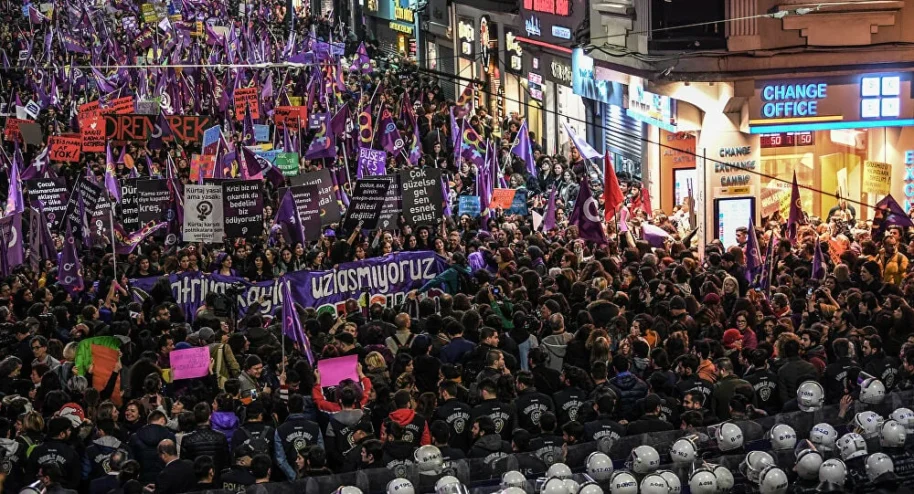
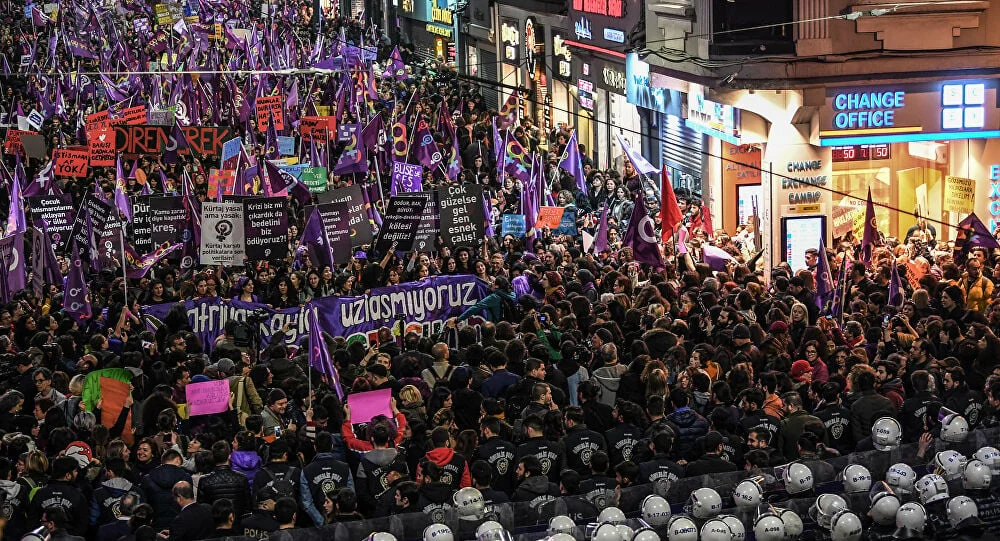
As for our respective contexts, the difference between Turkey and Argentina seems to be that Milei is Mad Max and Erdoğan is the Patriarch. Whereas in Turkey the method deployed to overcome the crisis of neoliberalism is to disregard even the most elemental principles of logic in order to criminalize all opposition, in Argentina the way out of the crisis seems to take on the form of unabashed “chainsaw capitalism.” Perhaps Milei is more consistently neoliberal in the narrower economic sense. The Turkish state espouses the rhetoric of protecting the people despite having thrown them to the lions by rendering constitutional rights and liberties ineffective. But this is also owing to the centuries-old state tradition (the hyper-centralized command structure of the Ottoman state is the model that even democratic politicians perpetuate in modern Turkey). In both our cases, however, the façade of arbitrariness is absolutely essential for destabilizing all frames of reference. A fait accompli not only clears the ground for permissiveness, it is itself a form of permissiveness. It is not a coup d’état in the strict sense but it nevertheless has the effect of a coup d’état. Erdoğan’s and Milei’s extraordinary actions appear unmediated; they evacuate the negative, so to speak. They are detached from the practical or discursive recesses of any recognizable order. This diminishes the legibility of power, hence the qualification of “arbitrary.”
Stockholm Center for Freedom
Erdoğan’s AKP (Adalet ve Kalkınma Partisi, or Justice and Development Party) government actually rode the tide of discredit (in the double sense) that brought down former alliances in the wake of the 2001 global crisis that first struck Argentina and then Turkey. Benefiting from the availability of cheap credit enabled by low Federal Reserve interest rates and from the inflow of “hot money” as well as predatory foreign firms into the Turkish economy, Erdoğan was able to finance mega-populist projects. The support he mustered was owed largely to his couching the selling out of national resources to multinational corporations in the language of development. Unlike the capitulating Argentina that you describe, Turkey was to become great again—way before the US embarked on that route with Trump.5 The showcase for this “greatness” was an irredentist foreign policy and the creation of enormous wealth. The latter was articulated to a populist appeal to “the people,” portrayed as being left out of the nation’s “greatness” by the secular republican elite. In contrast to Argentina, neoliberal Turkey set out by creating a middle class and ended up destroying it. Nepotism, monopolization, and accumulation through dispossession sped up after 2014. The Occupy Gezi uprising also showed that not everyone was swallowing the neoliberal pill. The discourse of the rebirth of the Turkish nation then transmuted into an unconcealed law of the survival of the fittest. Power, not development, became the magnet attracting support for the AKP. The party and its acolytes set the tone for how transactions are to be made from now on: stay with the party to take advantage of all extractivist opportunities or else face criminalization.
What is unprecedented here is that the closing of alternative horizons of possibility no longer works through military takeovers that seize or directly control institutional frameworks or infrastructures of action, but precisely by perverting these institutions. Instead of warfare, we now have “lawfare”: law has become an instrument for the destabilization of frames of reference. Legal shelterlessness aggravates neoliberal shelterlessness, as you put it, but it also incites both transgressive and punitive desires. The protective state is a façade concealing the coordination of extra-legal activity in the name of an order that produces such short-termism that it chokes alternative mobilizations. This, to me, is the form that fascism will take in the twenty-first century.
Gisela:
By contrast, in Argentina, the protective State is allegedly the enemy that threatens your autonomy. Trump’s wall, Erdogan’s patriarchal state, and the chainsaw are surely images for a false, reactionary re-empowerment. But if authoritarian ideologies in Europe and the US are generally based on the promise of re-empowering the state in order to “protect” the national collective figured as “under threat,” the Mileist neoliberal project is made up of quite different elements. On the one hand, in this pseudo-utopia, there are no “nations” or “national” conflicts, but rather a single world, beset by different avatars of repression or inhibitors of capitalism (“social-democrats,” “communists,” “collectivists,” and “Keynesians,” according to the categories in use by Milei).6 On the other hand, there is no “we” that one can pretend to protect. Instead the promise of agency—with its re-empowerment bait—is associated exclusively with isolated symbols: the lion, the lone person holding a chainsaw, the economic expert, the financial trader.
Furthermore, in “chainsaw capitalism,” the situation of crisis is not seen as something to be overcome by a new state of harmony. It appears as itself something consubstantial with the nature of Man and life. Milei gives up on the classic legitimation strategy of capitalism, where the crisis appears as a “moment,” as an exceptional, fleeting state that we are trying to minimize. He holds out no promise of reconciliation, and I believe that an important aspect of Mileism as a “popular” ideology is that the knowledge of this immanence without possible transcendence—and not the nostalgic and conservative postulation of a past to be recovered—seems to be a sign of power: a substantial part of the lion’s wisdom. In his discourse, the expectation of a time sheltered from crisis is indicative of a slave morality. True lions know that the state of exposure is without an outside: it is an “always,” without limits. While former neoliberal president Mauricio Macri’s slogan of “sincerity” called for an acknowledgment of our sins and a silent, daily sacrifice to pay our debts, Mileist immanence understands that indebtedness is existential and thus can only be managed, with varying degrees of success. Hence, the iconic figure of Mileism is no longer the neat, puritanical meritocrat who knew how to keep himself “clean” of debt, nor the hard-working entrepreneur eager to pay off the debts he incurred in order to reinvest. It is instead the broker or dealer in finance who no longer harbors expectations of redemption: he is the one who “knows” that debts are unpayable and that in order to “thrive in the chaos,” one has to manage those unpayable debts better than others.
And this brings us to the question of how this rhetoric came to effectively interpellate the population, and to another aspect of what we have called “flirting with the absolute”: arbitrariness. Denunciations of arbitrariness seem not to bother the government but instead to make it stronger, and I think this is because arbitrariness partly functions as a promise of pseudo-democratizing indifference. While the world of meritocracy is strongly hierarchical, the Mileist world has the appearance of leveling horizontality. It says that only the weak believe that the debt or crisis has temporal limits and naively hope to escape it (they are the ones who, in the president’s words, “do not see it”), while simultaneously inviting everyone to gamble. The world of the financial market seems absolutely blind to differences in birth and lineage; “anyone can become a millionaire in an instant with a phone in their hand, regardless of whether they have worked hard or not.” While Macrism—and even the last dictatorship—sought to hide the arbitrariness of power and to find external justifications both for the continuous sadomasochistic sacrifices that the people had to make in pursuit of a “return to order” and for the selection of the privileged recipients of its repressive policies, Mileism, on the contrary, seems to find part of its strength in the mere display of the fact that both the chainsaw and police repression can reach anyone and that we do not know if they will arrive or not, or when they will do so. Police repression and Mileist chainsaws are “random,” seemingly striking anywhere, spasmodically: they persist, but are simultaneously unpredictable to us. Sometimes they come, and sometimes they don’t. Or not yet. It is simplistic to understand this randomness as a sign of the limits of power (which it also is). This is because, on the one hand, the arbitrariness of that power creates the impression that, in its self-referentiality, that power has no external limits; the logic of Mileism is omnipotent in the sense that it constitutes the only possible frame of reference. On the other hand, this arbitrariness can translate politically into the expectation that, in these unpredictable actions by the executive, there is a kind of magic that escapes us but that could save us: precisely because he is willing to do anything—some people think—he might just succeed and secure our own salvation.
Preliminary Conclusions
We both notice that shelterlessness in Argentina and its apparent opposite, the protectionist discourse that actually only serves government acolytes and populist aims in Turkey, have the de facto effect of creating futurelessness, not only as a tactic to confound the enemy or the opposition, but as the inevitable consequence of a form of capitalism that cannot promise any utopia or aspire to reconciliation anymore. Neoliberal politics attempts to master the crisis of referentiality by liquidating history as an ongoing process, that is, by leaving no time either to grieve or to hope. Acceleration—as the impossibility of mourning losses in the face of the uninterrupted accumulation of crises—and the eternalization of the present should be seen as two constitutive and inseparable aspects of neoliberal presentism, which does not tolerate any distance from desire’s realization. Precisely because immediacy and absolutization were part of its modus operandi from the beginning, neoliberalism as seen from the “South,” did not become authoritarian/fascistic but was born as such.
However, this should not be read as a sign of neoliberal capitalism’s actual omnipotence. If neoliberalism had—and still has—to perform continuous rituals to evacuate the negative, this is precisely because social struggles also deflect actually existing neoliberal rationalities. Remembering these effective limits when accounting for neoliberal capitalist logics is a crucial task for a critical political standpoint.
Share this post:
- In this text, we use both “authoritarianism” and “fascism” to denote practices that are productive rather than merely repressive. We also need to clarify that the term “fascism” does not carry the same weight in the history of popular struggles in Turkey and Argentina. In Argentina, political formations harmful to life, equality, and freedom have tended to be referred to as “dictatorship” rather than “fascism.” Even today, in the marches against Milei, the slogan “Milei, you are the dictatorship” is heard much more often than “Milei, you are a fascist.” By contrast, “fascism” has come to name a wide range of political phenomena in Turkey, from military dictatorship to one-man rule, from social violence fomented by ultra-nationalist groups to the deployment of riot police to quash protests. The slogan that loosely translates as “arm in arm against fascism” is often used in democratic rallies in Turkey. [↩]
- Max Horkheimer, “Preface,” Zeitschrift für Sozialforschung 9, no. 2 (1941): 197. Horkheimer adds that in fascism, “[m]oral taboos and ideals are abolished; true is that which has proved serviceable.” [↩]
- All rights and liberties were suspended until 1983; all labor unions and political parties banned, 650,000 people taken under custody and tortured; and hundreds were sentenced to death. [↩]
- T. W. Adorno, Else Frenkel-Brunswik, Daniel J. Levinson, R. Nevitt Sanford, The Authoritarian Personality (Science Editions, 1964), 230. [↩]
- “New Ottomanism” was the form that greatness discursively took, the Ottoman Empire constituting the model to emulate rather than the Republic. [↩]
- See Milei’s speech at the World Economic Forum of Davos in 2024. Available at: https://www.youtube.com/watch?v=Pfcd0gWNIog [↩]