
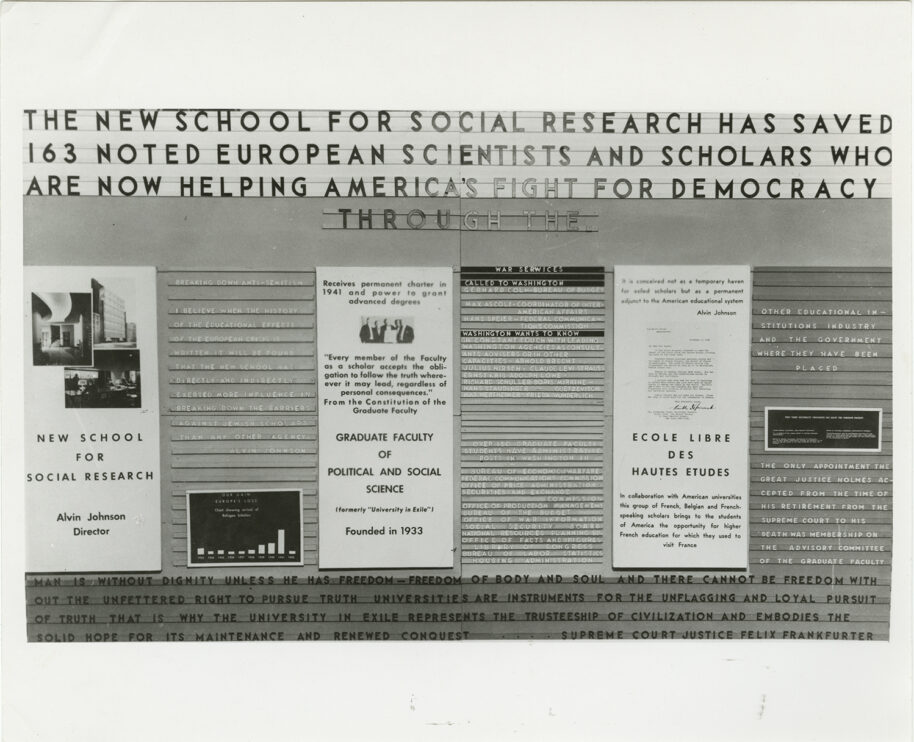
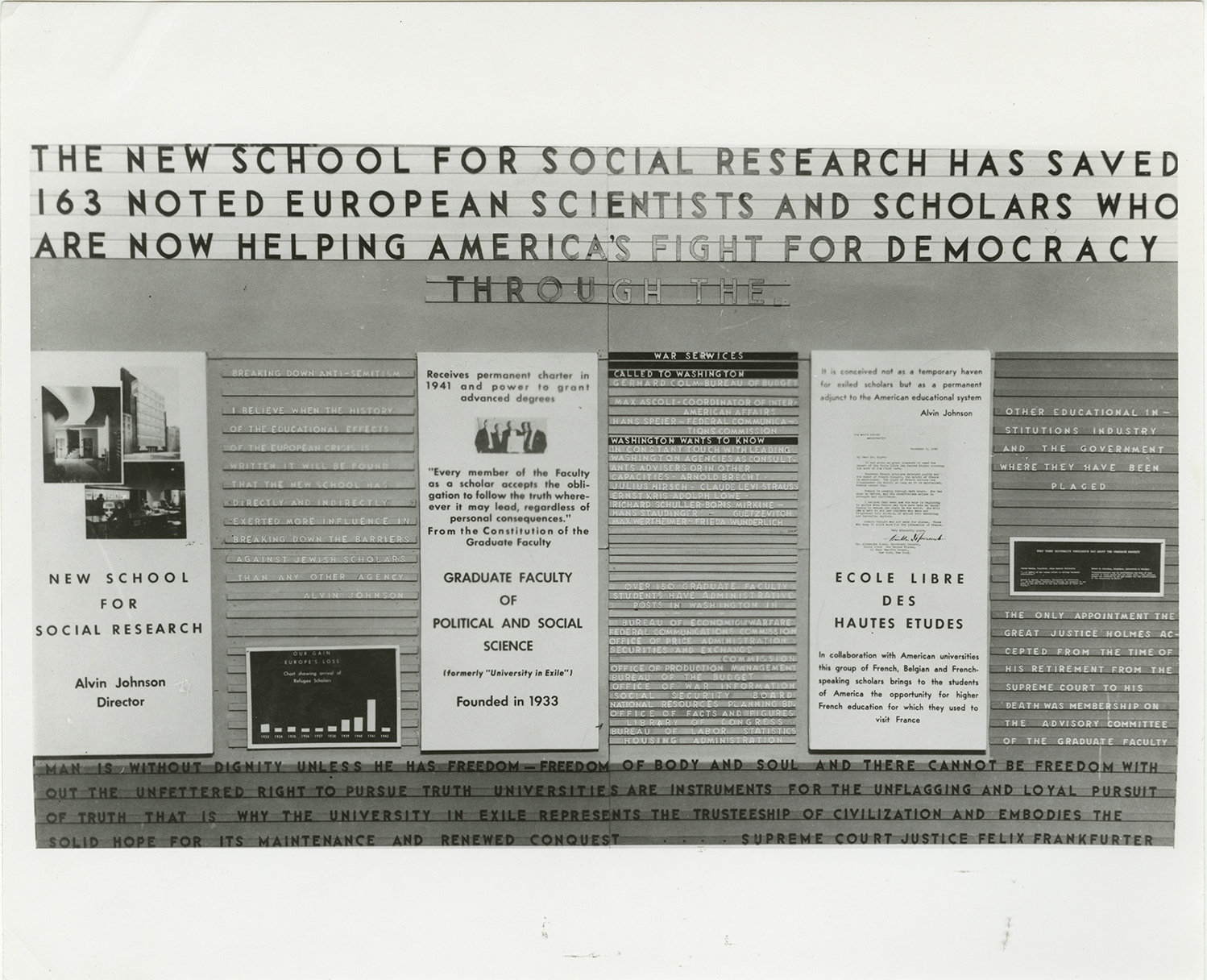
Wall Panel at The New School Probably During WWII. Photo Credit: The New School
The US’s recent authoritarian turn has brought with it attacks on universities that take aim at their commitments to free inquiry. Such attacks, predictable at a time when democratic norms are being shredded, are tacit acknowledgments of the importance of academic freedom for democratic life. Yet those launching the attacks often try to disguise their domineering ambitions by presenting themselves as academic freedom’s truest champions, say, by insisting they are making needed room for “viewpoint diversity” or “civil discourse.”
Recent events at The New School, the progressive university in New York City’s Greenwich Village, represent a striking case of such obfuscation. At first glance, this university seems an unlikely setting for an assault on academic freedom. The New School originated in, and still traces its identity to, far-reaching attempts to realize such freedom. Yet last year senior administrators at the school abruptly dismantled most of the main material structures of free inquiry. Far from being dissuaded by their institution’s history, these administrators seized on it in a brazen ideological inversion. In public addresses, they wove a narrative about how they were returning the institution to its roots and ushering in the truest realization of its founding ideals. Their slick and largely effective performance contains an important lesson about challenges faced today by those who strive to protect academic freedom. Successful efforts must include not only political mobilization but resources for the critique of damaging ideologies. They must include, that is, the free and critical social thought that successive generations of The New School’s scholars and creative practitioners fought to pursue, now endangered in the institution they built.
* * *
During the academic year 2025-2026, a handful of senior administrators at the New School carried out, with support of most of the university’s board of trustees and under guidance from management consulting firms, a major institutional “restructuring.” The rationale involved financial challenges the administrators pinned on a pandemic-era decline in enrollments, though critics argued that the groundwork for the difficulties was laid over more than a decade, as administrators borrowed to build one extravagant building, entered into an ill-judged lease for a dormitory, hiked executive pay faster than faculty and staff salaries, and spent freely on business consultants, without investing appropriately in admissions personnel and resources that could have aided recruitment and retention. The university’s financial problems tempted successive administrations to exchange its original understanding of higher education as a democratic good for a prevalent vision of education as a commodity to be profitably sold—a vision which, as wholly embraced by the university’s current president and provost, retraces a familiar austerity-themed path.
These two administrators orchestrated the firing of 19 full-time faculty members (ten tenured, two with extended employment, one with a successful tenure review, one tenure-track, and five with renewable term appointments) and 68 staff members as well as the resignation of numerous others who were pressed, at risk of being fired, into so-called “voluntary” departure deals. Unlike the president and provost, both trained in the arts, the work of those terminated or pushed out focused on the delivery of programs in the social sciences and humanities in the university’s graduate faculty, the New School for Social Science (NSSR), and its liberal arts arm, Eugene Lang College (Lang). Shortly before the terminations began, top administrators shuttered more than thirty programs primarily in these non-arts fields, devoting more resources to professional degrees at the university’s top-rated design school, Parsons. They “paused” admission to non-professional Ph.D. programs in the humanities and humanistic social sciences, passing on multiple offers to invest in these areas, including at least fourteen million dollars to endow the halted Ph.D. lines. The administrators apparently embraced the legal theory that, since their revamp was university-wide, and since faculty by-laws licensed firings in discontinued programs or divisions, there were no restrictions on who could be laid off.
The retrenchment had a distinct procedural face. The president and provost acted unilaterally, though always with the board’s support, destroying democratic institutional dynamics. They steamrolled tenure protections and sidelined deans, the faculty senate, and the part-time faculty union. Yet they hailed their reshaping of the university as “collaborative” and “collective,” having asked staff and faculty to spend the preceding year addressing restructuring plans in a parade of time-intensive working groups, charettes, and committees. These exercises were performative affairs designed to make it technically true that staff and faculty were “consulted,” while community-washing unpopular policies and undercutting protest. The president and provost formalized their centralization of power by treating their reorganization as nullifying divisional by-laws that contained self-governance policies. They relocated deans to the provost’s office and signaled that the provost would henceforth control domains previously treated as in the first instance the preserve of faculties or their divisional representatives (for example, the appointment of leadership positions such as deanships, for which the involvement of faculty search or selection committees had been standard).
Top-down, market-driven university restructurings that target the humanities and social sciences are now common in the US, in public as well as private institutions. Still, events at the New School were greeted as newsworthy. Partly this is because the actions of its president, provost, and board appear to be an especially blatant attack on tenure protections. For more than a century, academic tenure has been recognized in the US as key for safeguarding the free exchange of scholarly ideas. Since its 1919 founding, the New School has been the site of radical exercises in enacting academic freedom and supporting it abroad. Its reputation as an exemplar of such freedom has endured, with current faculty and students drawing on the university’s critical intellectual traditions (including strains of heterodox economics, decolonial theory, and the anti-totalitarian thought of Hannah Arendt) to expose mechanisms of authoritarian politics in the US and around the globe. Yet at a time when academic freedom is under attack, with the second Trump administration snatching students off the streets for pro-Palestinian speech, tying research funds to political allegiance, and filing lawsuits against universities that refuse to align programs and curricula with its MAGA agenda, this university famed for its unqualified defense of free inquiry turned on many of the members of its own community who were most energetic about exercising this freedom. Those fired or pushed out included outspoken advocates of Palestinian rights, local champions of academic freedom, and vocal critics of the university administration itself. In pressing these individuals to leave or firing them, the university deadened speech on campus. It did all this without any academic rationale beyond free-floating phrases about dismantling “silos” and fostering greater “integration,” consulting firm jargon that has been the cover for numerous austerity-driven university remodelings. The New School’s repudiation of academic freedom thus appeared deliberate and definitive. The resulting outcry has been vocal in the US (see coverage in Dissent, Democracy Now, The Chronicle of Higher Education, Jacobin, and The New York Times) and in many countries abroad (see coverage in Le Monde, Libertà e Giustizia, and the Frankfurter Randschau.)
These protests contradict the narrative of change recited by leadership at The New School. The president and provost insist they are bringing the university into better alignment with its original commitments. The president, who adopted “democracy” as one of four thematic axes of his administration (alongside “cities,” “technology,” and “climate”), regularly highlights the importance of academic freedom and other ideals that foster democratic responsiveness to “the times in which we live,” and he glosses these themes by saying that he is “remaking the New School in the spirit of its founding.”
This inverts the truth. In fact, the New School administration executed a corporatist reworking of the institution that razes its founding ideal of academic freedom. The view that education is a commodity to be bought and sold profitably is a substantive political view, and its use as a standard of institutional organization threatens the free pursuit of research or creative practice. The vertical deployment of this (or any other exogenous) metric to judge institutional success also jeopardizes university democracy, and, absent stable internal democratic structures, no university can justly claim the democratically decisive ideal of academic freedom.
The New School counts among its founding figures some of the thinkers who first articulated this conception of academic freedom. The founders devised structures to stymie the encroachments of administrators and donors within the school, while enabling free traffic in ideas to strengthen democracy without. They worked during years in which anti-democratic forces in the US and overseas endangered universities’ democratic missions, and they took the defense of academic freedom to be a political priority. Today, as the US government pressures universities to conform to its fascist agenda, this project remains urgent. Some universities have embraced the Trump administration. Many others have caved and used undemocratic methods to curb programs and forms of speech that attract censure. But a university organized along authoritarian lines has, as The New School’s founders taught, diminished its claim to uphold the academic freedom that is a university’s principal virtue. An institution called “The New School” that does this—for private, ideological, or financial reasons—represents an even greater scandal. It benefits from its name’s history while dishonoring the values that name represents.
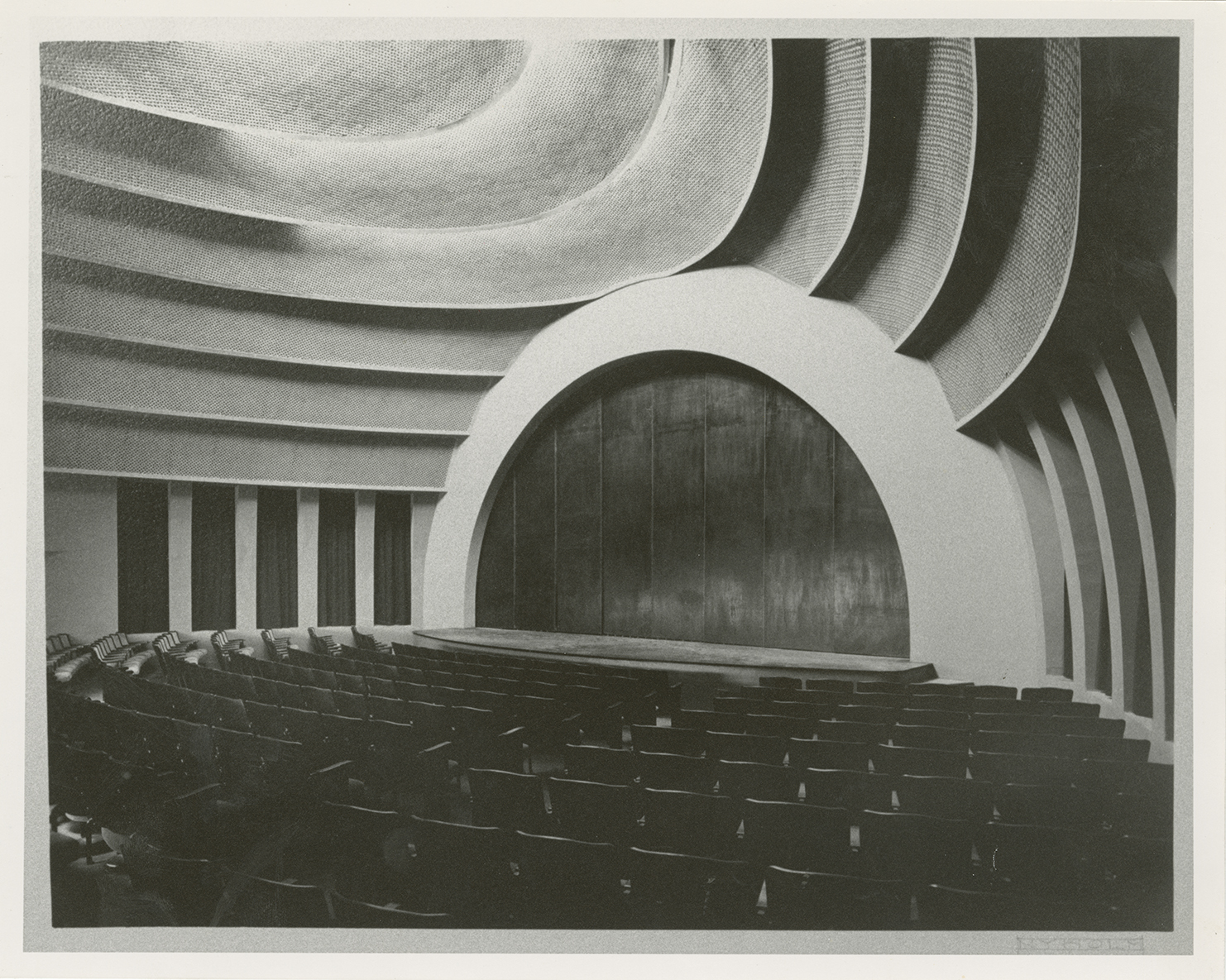
Auditorium of the 66 West 12th Street Building of The New School. Photo credit: The New School
Securing academic freedom was the impetus to the 1919 founding of the institution that, until 1997, was known as “The New School for Social Research,” and that, since 2005, has been called “The New School.” The galvanizing event was Columbia University’s firing of two professors for pacificist speech after the US entered World War I. This prompted two other members of its faculty, historians Charles Beard and James Harvey Robinson, to resign in protest. Politically motivated firings and protests of them were not uncommon at the time. A politically driven firing at Stanford in 1900 led philosopher Arthur O. Lovejoy to resign, and, in 1915, Beard’s and Robinson’s Columbia colleague, philosopher John Dewey, who later offered classes at their new institution, joined with Lovejoy to co-create the American Association of University Professors (AAUP) to defend free academic work. Unhappy with Columbia, Beard and Robinson met with others in offices of The New Republic to design an institution that would protect the freedoms Columbia had failed to respect.1
One source that illuminates the project’s origins is a 1918 pamphlet, A Proposal for an Independent School of Social Science, that is both manifesto and funding pitch by the institution’s Organizing Committee. The leaflet’s titular emphasis on social science was provocative, since sociology, anthropology, political science, psychology, and economics (as opposed to political economy) had been recognized as disciplines only in the late nineteenth century. The inspiration came partly from the two historians central to the enterprise. Robinson and Beard, teacher and student, had started the “New History” movement, which exchanged a traditional emphasis on wars, kings, and legal documents for the use of the nascent social sciences in making sense of the past. They believed that this would aid progress by transforming our understanding of the “problems and prospects of mankind.”2 A corollary is that we are obliged to be ever open to new standards for assessing whether problems are rightly addressed.
The New School’s inaugural brochure makes this point about the assessment of research that draws on the social sciences. At issue, however, is a point about how all thought has revolutionary potential and about how the identification of appropriate standards is thus a matter for subject- and occasion-sensitive judgment. When the school was founded, Dewey was well known for an educational philosophy that accented this view of the power of thinking irrespective of domain. For him, thinking not only in the social sciences but also in the natural sciences, humanities, and the arts has the capacity to be disruptive. In Democracy and Education (1916), he argues that education opens the mind to new pathways, revealing the need for novel metrics. So, education’s aims cannot be given from outside. Any external aims or metrics will, Dewey urges, “limit intelligence because, given ready-made, they must be imposed by some authority external to intelligence.” Since “the object and reward of learning is continued capacity for growth,” the aim of education can only be “to enable individuals to continue their education.”3
This generalization of the brochure’s theme sheds light on The New School’s trajectory during its first fifteen years. The school initially focused on social science instruction, with nearly every course on social sciences and the remainder on related themes in philosophy, history, and public policy, with some vocational courses aimed at union members. The early years were heady, with lectures by luminaries in the social sciences, history, and philosophy, and the institution’s offerings aroused great excitement.4 Still, the school ran a deficit that outstripped its resources, and in 1922 financial difficulties led to the departure of most of its social science faculty. That year, it expanded its offerings to courses in studio and performance arts. The inclusion of the arts was faithful to a concern with social understanding, since the arts contribute to shaping and articulating social conditions, and, by 1925, The New School had pivoted to popular lectures in drama, dance, literature, visual arts, and music. This was a change in but not a repudiation of its ambitions.
The works of the painters, composers, architects, and dancers who taught at the school were decidedly modernist.5 Modernist art departs from established aesthetic forms with an eye not to rejecting but to staying true to tradition. Artistic modernism is, as American philosopher Stanley Cavell put it half a century later, the awareness of a “continuous revolution”6 and the joining of a continuous quest for critical terms. The productions in the arts emerging from The New School, like the social research to which it aspired, were radical in raising questions about the standards by which they could be assessed. To protect the arts required an artistic freedom that was an aspect of the academic freedom that was the founders’ primary commitment.
The founders’ vision of the social sciences focused on research that was world-oriented. Their inaugural leaflet opens with a declaration about how “[t]he political and social problems forced upon the country by the economic development of the past twenty-five years” created a need for “teachers who have a first-hand knowledge of the world of actual endeavor and are prepared to apply their several specialties to the current issues of the day.”7 The founders disagreed about the kind of engaged teaching at issue. At least one—Herbert Croly, founding editor of The New Republic—favored vocational courses for civil servants and labor organizers, but the dominant view, defended by Robinson and others, called for exposing students to research that sheds novel lights on existing social structures, raising new social questions.8
Such world-engaged social science research is, paradoxically, sometimes described as “impractical.” That is because it rejects the task of solving pre-given problems and so remains detached from existing instrumentalities. This is a theme of the work of economist Thorstein Veblen, who taught at the New School from the start, stayed for seven years, and arguably contributed more to the conception of the institution than any other individual. A few months before The New School opened, Veblen published a scathing book-length critique of the American university system, The Higher Learning in America, arguing that the original work that distinguishes a university is “not ‘practical’ in the slightest degree.”9 Veblen didn’t deny that such work supplies raw material for technical and professional efforts. But he rejected a practicality involving the rote effort to solve established problems. For him, original research had what could be called a practical impracticality. This aspect of Veblen’s work shaped the founding not only of The New School but also of Princeton’s Institute for Advanced Study. The Institute’s founder, educator Abraham Flexner, channels Veblen in his own classic 1939 essay The Usefulness of Useless Knowledge. The Veblenesque, practically impractical research that Flexner later cultivated in Princeton, initially in mathematics, was what the New School’s founders wished to foster, initially in the social sciences.
The founders’ ideas about protective institutional arrangements were far-reaching. They opposed all university structures that might outsource decisions to those not engaged in the thinking that is the university’s lifeblood. They bemoaned that “[o]ur college and university presidents are pathetically responsible to an uncritical public constituency made up of trustees, parents, alumni, prospective donors and casual newspaper reporters and editors” and that the “one consideration that they can always safely neglect is the scientific conscience of the members of their faculties.”10 They set up a school in which “a small corps of selected specialists” enjoyed complete self-governance regarding appointments and dismissals.11 There was no president, no cadre of administrators, and no endowment. There were also no degrees, an omission necessitated by the lack of endowment that may have been rationalized as a necessary sacrifice. The institution’s charter required a board, and the founders, having put faculty in four of the board’s eleven seats, tried to limit the board’s purview to management issues.12 The endeavor’s heart was a schedule of magnificent nighttime lectures for adults seeking continuing education.
Several aspects of this bold experiment were soon abandoned. In 1919, the board appointed Robinson as chairman, and, with administrative backup, he served in that role until the troubles of 1922, when he, Beard, and others left. The board then named as director a board member who had previously remained in the background, economist Alvin Johnson. Necessity forced Johnson to assume a more formal role, and he would retroactively be dubbed The New School’s first president. He quickly began working to improve the university’s finances. He was aided in this, and in all he subsequently did as president, by Clara Mayer, a founding board member, gifted administrator, successful fund-raiser, and donor, who stayed on until 1961, working with three further presidents and herself becoming dean and vice-president.
The New School in its post-1922 instantiation did not sacrifice academic freedom. The university, which was the first to focus exclusively on the higher education of adults, then emphasized students’ freedom of ideas. The institution’s stress on learning as opposed to certification was not distinctive in the post-World War I period, which saw an upswing in adult vocational training. But it stood out for emphasizing not individual development but society’s welfare. And, under Mayer’s guidance, students were encouraged to be active in shaping the curriculum. This stress on students’ freedom of thought at what was later referred to as the university’s “Adult Division” was central to the school’s mission well into the second half of the twentieth century, and thereafter it remained an important if not primary concern.
However unrealistic, The New School’s 1919 experiment in academic freedom was a sincere attempt to realize a democratic mode of education. The school’s founders recognized that American industrial society was full of inequities and that only thinking capable of rebelling against entrenched ideas and propelling change toward greater inclusion could serve “the great purposes of a democracy seeking all the light it can obtain upon its own pressing problems.”13 Dewey sounded these themes regarding “progressive education,” his term for democratically apt education harboring thought’s radical prospects. “It is,” he wrote, “the aim of progressive education to take part in correcting unfair privilege and unfair deprivation, not to perpetuate them.” Otherwise “there is danger that industrial education will be dominated by acceptance of the status quo.”14
If there were any truth to the idea that the New School’s current administration is channeling its founding spirit, the 1919 founding could not be its touchstone. This administration exemplifies the hierarchical institutional arrangements that the founders recognized as threats to free academic activity. Its prioritizing of professional degrees above “practically impractical” basic research and practice across the social sciences, humanities, and arts is likewise a rebuke to the founders’ vision. There was, admittedly, no tenure at the original New School. But this was because the founders’ commitment to faculty self-governance was so absolute that tenure seemed restrictive. It provides no comfort to an administration that throws off the restraints that tenure and related norms place on its authority. Further, in the 1920s, Johnson made pragmatic, market-based decisions to keep the New School afloat. But during the same period, he and Mayer argued that rebuilding the social science faculty was essential to the school’s mission.15 They knew this would require investment, and they had no truck with the idea that an educational endeavor requiring financial support is less valuable than one with direct revenue streams.
If the current president and provost had been obliged to present their plans to The New School’s original, engaged, and far-thinking board, they would have met with blank hostility. Still, perhaps, in claiming to return to the school’s initial mission, they have in mind a different moment.
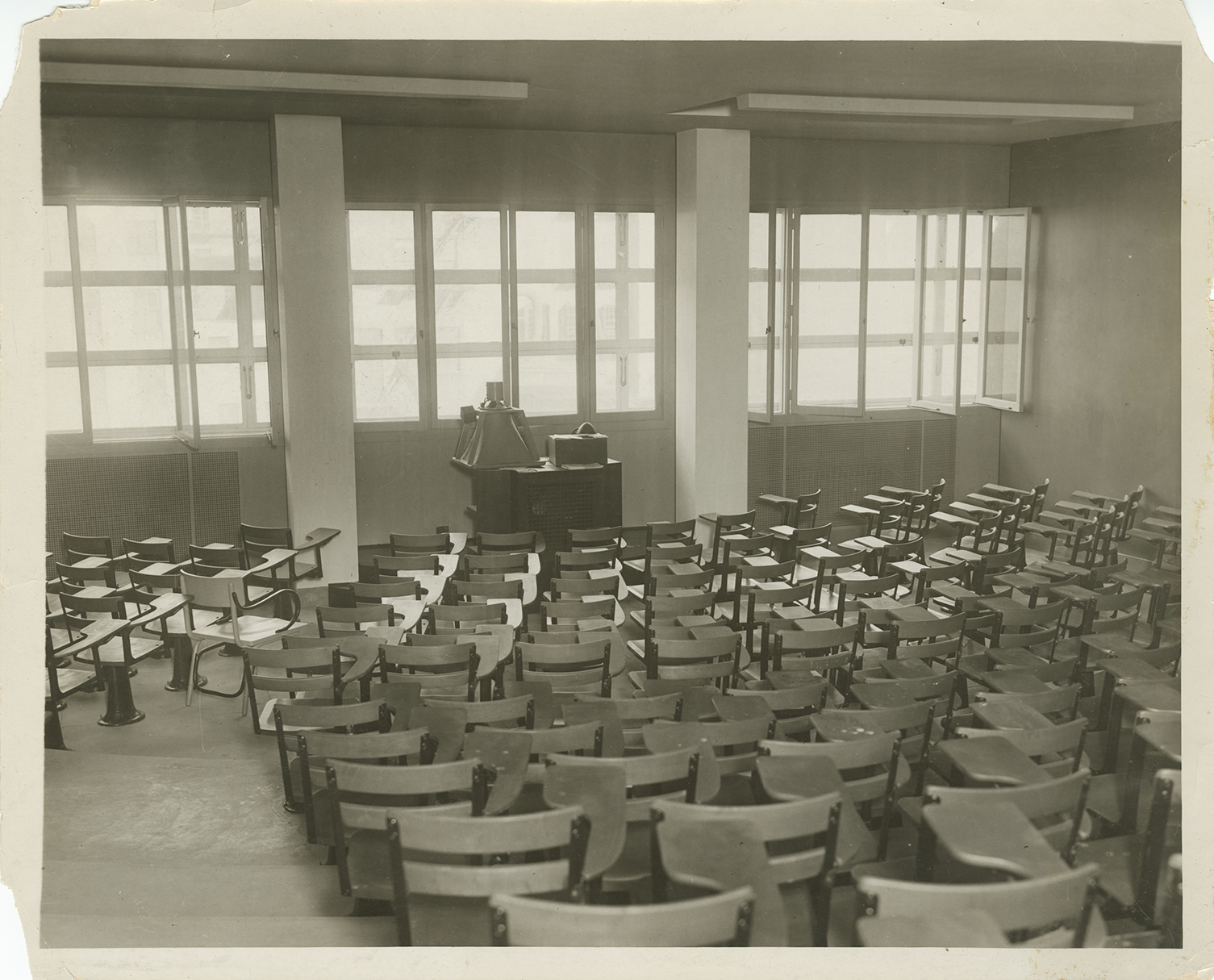
Classroom in 66 West 12th Street Building of The New School. Photo Credit: The New School
Fourteen years after it first opened its doors, The New School established the freely governed faculty dedicated to interdisciplinary social science research its founders envisioned. This faculty was initially, in fall 1933, composed of nine German social scientists, primarily economists, political scientists, and sociologists, who had lost positions on April 7, 1933, when the Nazi regime passed a law excluding “non-Aryans” and political opponents from civil service jobs like university professorships. Alvin Johnson grasped what was happening and acted swiftly. He was then associate editor of the Social Science Research Council’s encyclopedia of social science, and he had become acquainted with German academics while traveling in search of contributors. When the Nazi law resulted in the dismissal of his new friends and colleagues, he quickly hit on the idea of a German university in exile. By mid-May he had money to bring fifteen scholars to New York. Other organizations, such as Princeton’s Institute of Advanced Study, rescued groups of German scholars, and The New School itself got help from the Rockefeller Foundation. In total, the university gave faculty positions to roughly a fifth of the social scientists forced out of Europe in the years after Hitler’s rise.16 A research faculty, the “University in Exile,” opened its doors in the fall of 1933.
Events in Germany and other parts of Europe were, for members of The New School community, dreadful confirmation of their views about the importance of academic freedom and its close tie to the intellectual freedom that is democracy’s hallmark. The confirmation was arresting for Johnson because—like the drafters of the AAUP’s 1915 statement on academic freedom—he traced US universities’ recognition of the import of this freedom to awareness of the unfettered conditions for research in German universities in the nineteenth century. It was shocking that these universities were showing the world how the loss of liberty for research constricts the free exchange of ideas in society. In 1933, Johnson addressed these matters, partly to rouse more colleagues in the US to join his rescue efforts and partly to counter complacency about liberty in the academy at home. He rejected the idea that political meddling in US universities was an isolated phenomenon. Recognizing that the profit motive threatened free inquiry, he asked rhetorically: “Do our financial kinglets and their stewards in academic government love liberty?”17
Johnson ensured nearly unbridled academic liberty for the new social science graduate faculty, which was licensed to offer the university’s first degrees—masters and doctorates. The faculty would be free to manage its own organization, curriculum, hires, and faculty reviews; its members would choose their own dean; and they could, with limited constraints, express themselves politically and participate in politics.18 Johnson started a “General Seminar,” for faculty members to discuss overlapping research concerns, many having to do with resistance to anti-democratic menaces, and he founded a journal, Social Research, to publish the seminar’s results. The 1933-1934 course catalogue for the graduate faculty, known since 2005 as NSSR, declares: “every professor in the Graduate Faculty will be absolutely untrammeled, teaching freely and fearlessly what he believes to be the truth.”19
German philosopher and political theorist Hannah Arendt would not join the faculty at The New School full-time until 1967, 34 years after the University in Exile was established and 16 years after publishing the book, The Origins of Totalitarianism that made her a leading political thinker. But her writings give an important twist to the idea, pivotal for the university’s founders and later associated with the University in Exile, that full-blown thought and action resist determination by existing forms and encode the promise of the revolutionary or “new.” This notion features centrally in Arendt’s account of the difficulty of understanding reality. Understanding requires not the mere application of existing categories but openness to how fidelity to the world can oblige us to rework our categories. Arendt makes this point in reference to the challenge of grasping totalitarianism’s character. “Comprehension,” she writes, “does not mean denying the outrageous, deducing the unprecedented from precedents, or explaining phenomena by such analogies and generalities that the impact of reality and the shock of experience are no longer felt”. Rather, it means the “unpremeditated, attentive facing up to, and resisting of, reality—whatever it may be.”20 This practically consequential intellectual capacity, which Arendt later calls natality,21 and which she traces through revolutions of the late 18th century,22 is, for her, the final staging ground for resistance to unjust forms of domination. As long as we preserve our natality, a less oppressive future is possible. These Arendtian themes add a dimension to the way “the new” was understood by members of The New School community.
In the years just after 1933, Jonhson started to raise an endowment for the University in Exile. German novelist Thomas Mann agreed to speak, in 1937, at a fund-raising event featuring a two-day conference. Mann concluded his remarks by describing how, in an act that “should put every German to shame,” the Nazis had removed from a new building at the University of Heidelberg an engraved inscription reading “to the living spirit,” replacing it with the words “to the German Spirit.” The deleted motto was from literary scholar Friedrich Gundolf, who, in lauding the “living spirit,” was calling for creative and free thought. Those listening to Mann’s speech knew that, through the late nineteenth century and into the early twentieth, German universities had furnished conditions for sustaining such thought and that Hitler’s government was eliminating these conditions. What was lost was, as The New School’s sixth president, Jonathan Fanton, later put it, “the tradition of free and unfettered inquiry that had thrived for so long in the German university system.”23 When Mann proposed that his US hosts adopt the slogan “to indicate that the living spirit, driven from German has found a home in this country,” he was offering a ringing endorsement of The New School for its commitment to academic freedom.24
The University in Exile incorporated the motto into its Charter, and NSSR, the University in Exile’s direct descendant, inherited its concern with academic liberty and interdisciplinary social science research as routes to democracy. For instance, since the 1960s, NSSR has hosted the Theodor Heuss Professorship, a post for distinguished German academics created and funded by the German government to express gratitude to NSSR for giving refuge to scholars fleeing the Nazi regime. In 1970, psychologist Arien Mack took over Social Research and went on to found the “Endangered Scholars Worldwide” initiative, using the journal to document attacks on higher education before later sustaining similarly oriented communities through the New University in Exile Consortium. In the 1980s, a group of faculty engaged with Eastern and Central European intellectuals helped start an underground Democracy Seminar in Warsaw, Budapest, and New York, a project which, under sociologist Elzbieta Matynia, evolved into the Transregional Center for Democratic Studies, which supports a democracy-building institute and a Courage in Public Scholarship Award given to dissident intellectuals such as Adam Michnik and M. Gessen. All these initiatives were running through last year.
The University in Exile is not the heritage of one part of The New School alone. It was, from the start, devoted to protecting groundbreaking work that could shift how social issues are seen and aid pro-democratic endeavor. This work qualifies as “new” in the sense of The New School’s founding social scientists, artists, performers, and humanists, as well as in Arendt’s later anti-fatalistic sense. A commitment to newness, thus construed, is university-wide.
This is true of the university’s first unit, the Adult Division, which, after first stressing modernism in the arts, turned in the late twentieth century and early twenty-first, to equally “new” work in urban policy and media studies. Lang College, which was founded in 1985, and which started to develop shared social science and humanities departments with the NSSR in 1999, has at times prompted the rest of the university community to advance its thinking about, for instance, gender, race, and coloniality. A commitment to “newness” is also typical of Parsons, born in 1896 as the Chase School of Art. Parsons faced closure when it was saved by The New School in 1970 and is now dedicated to future-facing, revolutionary practice in fashion, constructed environments, and media. And Mannes, one of the university’s two music divisions, joined the university in 1989 when likewise facing closure. Having had a conservative concentration on European masterworks, Mannes shifted to the experimental, “new” New School style. Because all aspire to tradition-transcending research and creative practice, all parts of the university are at risk from an administration intent on top-down management and assessment.
This captures the absurdity of any suggestion that the university’s current administration respects the spirit of the University in Exile. This administration disdains the academic freedom that is that moment’s heart and soul. The university’s chosen mechanism, in 1933, for ensuring such freedom, was tenure, and, although the University in Exile was initially alone in offering tenure, other parts of the university partly adopted it, and The New School has spent the last fifteen years implementing university-wide procedures for tenure and other employment protections. It is these protections, legacies of 1933, that the administration has rendered meaningless. The administration also directly targeted the University in Exile’s successor faculty, the NSSR, firing and pushing out faculty and staff, depriving its remaining faculty of a dean and the right to self-governance, taking steps toward breaking its departments into programs, and moving the remainder into a poorly resourced division with Lang. Faculty were told to keep using the name “NSSR,” but, since the NSSR’s by-laws have been thrown out, this is less a kindness than a smokescreen obscuring its dissolution.
It is hard to imagine a cleaner or more complete break with the project of the University in Exile. Even so, when the president peppers his public remarks with comments about remaking the university “in the spirit of its founding,” this is a key reference point.
* * *
The heart of the graduation speech that The New School’s president gave to his community on May 18, 2026—mere days before termination notices went out to faculty members—was the story of Mann’s ceremonial delivery to the University in Exile of the motto “to the living spirit” in 1937. In telling the story, the president offered a faithful interpretation of Gundolf’s motto as “proclaiming the aspiration for a community committed to free thought and creative individuals who embody and transmit living knowledge.” Just before sharing his version of the tale, the president rightly glossed “the living spirit” as dedication “to free inquiry.” A moment later, he closed his speech by telling graduates that “‘to the living spirit is yours now, too’.”
A university administrator who simultaneously destroys the material structures and practices constitutive of a community of free inquiry and publicly declares that, in his eyes, free inquiry is the institution’s noblest ideal is aptly described as gaslighting. To be sure, the president may be partly convinced that academic liberty has the standing of a mere brand that floats free of material structures. He may believe that a university that disdains its faculty’s employment protections and scorns its shared governance structures can still lay claim to this brand. That fits the financialized view of education that The New School’s administration and board have so thoroughly embraced. If a university takes its core activity to be profitably selling classes, degrees, and programming, and if it assumes that a prime measure of the “innovativeness” of its products is that they sell well, then it will seem that it is not just licensed but obliged to make use of any powerful brand at its disposal, even if it is busy dismantling the practices that once lent that brand truth.
This way of thinking, depressingly common in the US today, jars painfully at The New School. The university’s founders contributed, with blood, sweat, and immense insight, to writing the book about how academic freedom requires weighty institutional protections. The suggestion that they could have arrived at conditions for free inquiry with the right branding alone would have struck members of the Organizing Committee of 1919 as a bad joke, and it would have struck members of the University in Exile as a cruel one. Not only did these scholars recognize that a university built like a corporation couldn’t reliably protect the free pursuit of ideas and modes of artistic expression that a democracy needs. They also knew that, in times of growing authoritarianism, such a university would be inclined to protect its bottom line by restricting democratically important research and practice that challenged the status quo and thus opened it to political censure.
Today chaos still reigns at The New School. It appears that, from the start, the president and provost had a plan that appealed to them as former deans, respectively, of Parsons and Performing Arts. They would drastically reduce full-time social science and humanities faculties, retaining just enough people to administer liberal arts degrees to Parsons and Performing Arts students, and supplement this faculty with a large cadre of more poorly compensated part-time instructors. They would get there by facilitating collapse: Thus, though the biggest drop in enrollments has been at Lang, the dean who presided over it now also oversees the remnants of NSSR and the former Adult Division (known as the Schools of Public Engagement [SPE]); though the university is spending notably on recruitment at Parsons-Performing Arts, there isn’t an analogous effort at Lang-NSSR-SPE; and though the university is fundraising energetically for Parsons-Performing Arts, there isn’t meaningful attention to the negative impact on M.A. recruitment at former NSSR and SPE of department closures, loss of faculty and staff, and the so-called Ph.D. “pause.”
Meanwhile the selling of the university’s free inquiry “brand” continues. In his public welcome for the 2026-2027 academic year, the president claimed to be renewing the “audacious commitment,” characteristic of the university since “its founding in 1919,” to “the ongoing process of remaking higher education for the needs of the time in which we live.” His administration is working on funding for a Hannah Arendt Chair; it renamed its distinguished teaching awards for Clara Mayer; and it is backing the creation of new centers that do high-profile public programming and distract from the hollowing out of the university in which they are located.
Stories of The New School’s founding are about something far more substantial than branding. They are stories about what academic freedom is, what material resources sustaining it requires, and why doing so matters. Brought together with the story of The New School’s present, they illustrate that, at a time when political norms and the norms of civic institutions like universities are being trampled, academic freedom can be snatched away. They also illustrate that the fight to recover this freedom needs to start with a struggle for the recognition of its loss, a struggle that will require use of the kind of critical thought for which the university’s founders strove to create space.
* * *
Epilogue. This essay was written in solidarity with faculty members and staff at The New School who have lost their livelihoods and with all those at the university who have suffered the shattering of their community. It was written with love for The New School and its ideals. There may be a temptation to think that those who mourn the end of this university’s liberating traditions must have an inflated sense of the importance of a small, imperfect, idiosyncratic, private university. It is true that humanities and social science departments at The New School could never be expected to surpass the world’s largest and wealthiest research universities in ways capturable by standard quantitative measures of things like faculty recruitment and student placement. But it reflects a misunderstanding to think that this is the right standard for their success. What a small private institution of higher learning can do is identify significant values that don’t receive adequate attention in society at large and insist on actualizing them. If it realizes them with great thought, intensity, and passion, as The New School has realized the free pursuit of social understanding toward greater democracy, then it can have, as The New School has, an influence massively out of proportion with its size. That is something worth investing in, especially at times, like the present, when democracy is under open attack.
Note of acknowledgement. This essay could not have been written without the extremely knowledgeable commentaries and observations of a few dozen current and former faculty members, administrators, and students at The New School. I am profoundly grateful for my friends’ and colleagues’ assistance.
Share this post:
- See Judith Friedlander, A Light in Dark Times: The New School for Social Research and Its University in Exile (Columbia University Press, 2019), prologue and chapter 1. [↩]
- James Harvey Robinson, The New History: Essays Illustrating the Modern Historical Outlook (Macmillan, 1912), chapter 1. [↩]
- John Dewey, Democracy and Education (Macmillan, 1916), 122, 117. [↩]
- Friedlander, A Light in Dark Times, 54. [↩]
- Peter M. Rutkoff and William B. Scott, New School: A History of the New School for Social Research (The Free Press, 1986), chapter 3. [↩]
- Stanley Cavell, Must We Mean What We Say? (Cambridge University Press, 1969), 189. [↩]
- A Proposal, 3. [↩]
- Friedlander, A Light in Dark Times, chapter 4. [↩]
- Thorstein Veblen, The Higher Learning in America: A Memorandum On the Conduct of Universities by Business Men (B. W. Huebsch, 1918). [↩]
- A Proposal, 6. [↩]
- A Proposal, 15. [↩]
- Friedlander, A Light in Dark Times, 55-58. [↩]
- A Proposal, 12. [↩]
- Dewey, Democracy and Education, 140, emphasis in original. [↩]
- Rutkoff and Scott, New School, 40-41. [↩]
- See Rutkoff and Scott, New School, 96. See also Friedlander, A Light in Dark Times, 89-91. [↩]
- Alvin Johnson, “Intellectual Liberty Imperilled,” The American Scholar 2, no. 3 (1933): 318. [↩]
- Rutkoff and Scott, New School, 104. [↩]
- Quoted in Jonathan F. Fanton, The University and Civil Society (New School for Social Research, 1995), 95. [↩]
- Hannah Arendt, The Origins of Totalitarianism (Meridian Books, 1951), viii. [↩]
- Hannah Arendt, The Human Condition (University of Chicago Press, 1958), chapter 1. [↩]
- Hannah Arendt, On Revolution (Penguin, 1963). [↩]
- Fanton, The University and Civil Society, 98. [↩]
- See Friedlander, A Light in Dark Times, chapter 8. [↩]